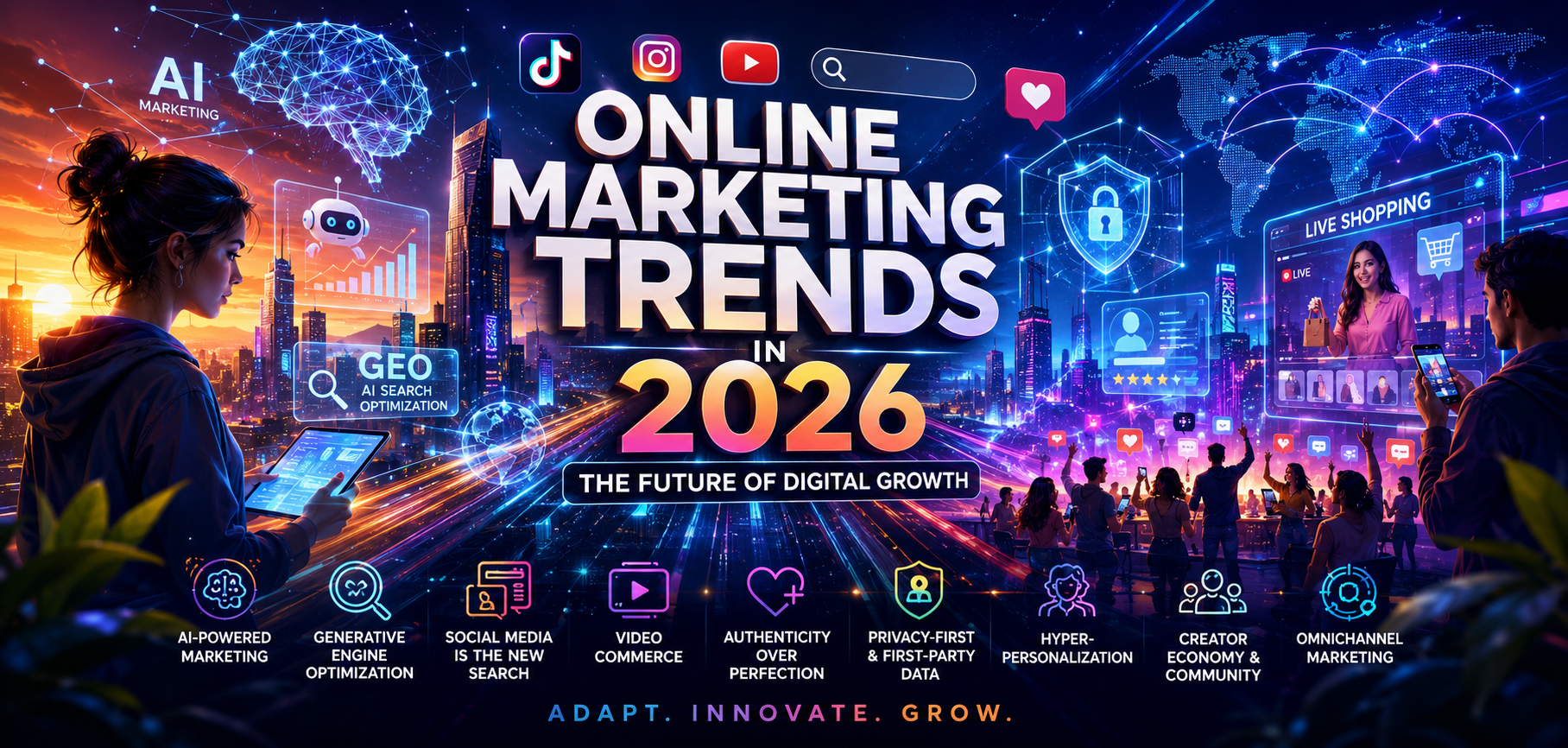
Online marketing is evolving faster than ever. Artificial intelligence, changing consumer behavior, privacy laws, and new content formats are reshaping how brands attract customers and generate revenue.
Businesses that adapt early will dominate search results, social media, and digital advertising.
In this SEO guide, we’ll explore the most important trending topics in online marketing for 2026 and how to use them to grow your brand.
🤖 1. AI Is Becoming the Core of Online Marketing
Artificial intelligence is no longer just a tool — it’s becoming the operating system of marketing.
From content creation to customer targeting, AI is changing every step of the marketing funnel.
Why AI marketing is booming
- Automates repetitive tasks and reduces costs
- Customers start their buying journey with AI tools
- Predicts customer behavior and boosts personalization
- Improves ad targeting and campaign performance
How to use this trend
- Automate email campaigns and ads
- Use AI for content research and ideation
- Implement chatbots for customer support
- Analyze customer behavior with predictive analytics
🔍 2. Generative Engine Optimization (GEO) Is the New SEO
Search engines are changing. Users increasingly receive instant AI answers instead of clicking links.
This shift introduces a new discipline:
Generative Engine Optimization (GEO)
GEO focuses on getting your brand mentioned in AI-generated answers, not just ranking in search results.
GEO strategies
- Create expert and trustworthy content
- Use structured data and schema markup
- Build strong brand authority
- Publish content that answers real questions clearly
📱 3. Social Media Is the New Search Engine
Younger audiences now search on TikTok, Instagram, and YouTube instead of Google.
Social platforms have become powerful product discovery engines.
Why social search matters
- Short-form videos drive discovery
- Algorithms recommend content based on intent
- Users trust creators more than traditional ads
How brands should adapt
- Optimize videos with keywords and captions
- Focus on storytelling and entertainment
- Use TikTok SEO and YouTube Shorts strategies
- Treat social media like a search engine
🎥 4. The Rise of Video Commerce
Video is no longer just for engagement — it’s now a sales channel.
Shopping is increasingly happening inside video platforms.
Winning video strategies
- Live product demonstrations
- Short educational videos
- User-generated content
- Influencer collaborations
💛 5. Authentic Content Beats Perfect Content
Audiences are experiencing digital fatigue and crave real, human content.
Highly polished marketing is losing effectiveness, while authenticity is winning.
What audiences want now
- Real stories and experiences
- Honest reviews and opinions
- Educational and useful content
- Human connection and transparency
How to build trust
- Share behind-the-scenes content
- Showcase real customers
- Focus on long-term relationships
- Avoid overly polished messaging
🔐 6. Privacy-First Marketing and First-Party Data
With the decline of third-party cookies, businesses must rethink data collection.
First-party data is becoming a major competitive advantage.
What this means for marketers
- Email lists and CRM data are critical
- Consent-based marketing is essential
- Personalization relies on owned data
Strategies to adopt
- Build email and SMS lists
- Offer lead magnets and memberships
- Create loyalty programs
- Use surveys and quizzes
🎯 7. Hyper-Personalization at Scale
Consumers expect brands to understand their needs instantly.
AI now allows real-time personalization across multiple channels.
Examples of hyper-personalization
- Product recommendations
- Dynamic website content
- Personalized ads
- Behavior-based email campaigns
👥 8. Creator Economy and Micro-Communities
The creator economy continues to grow rapidly.
Brands are shifting from huge audiences to niche communities and loyal followers.
Why community marketing works
- Higher engagement
- Stronger trust
- Long-term loyalty
- Lower acquisition costs
🌐 9. Omnichannel Marketing Is Now Mandatory
Marketing no longer happens on a single platform.
Success depends on a multi-channel presence across:
- Search engines
- Social media
- Email marketing
- AI assistants
- Messaging apps
A unified brand presence improves engagement and ROI.
🧠 Conclusion: The Future of Online Marketing
Online marketing in 2026 is driven by AI, authenticity, personalization, and community.
Key takeaways
✔ Optimize for AI search and GEO
✔ Treat social media as a search engine
✔ Use video and creators to drive sales
✔ Build first-party data and personalization
✔ Focus on trust and real human connection
The future belongs to marketers who combine technology with authenticity.